Thursday, November 10, 2016

Jawdropping Jerash

Amazing. Astounding. Fantastic. Stupendous. Marvelous. Gorgeous. Beautiful. Have you noticed that those words and others of the sort seem to populate my posts? That's because everything we saw fit those parameters.

Jerash was even more so. 

Jerash is said to be the largest Roman ruin still in existence outside of Rome. I'm not sure any of us had ever heard of Jerash before our arrival, and none of us expected to see anything of its size . . . except perhaps Petra. This was beyond our imagining.


This is a video of Bedouin Police playing bagpipes and drums in the theatre at Jerash. 

When we first entered the ruins via Hadrian's Arch, I was pretty impressed already.


You can gauge the size of the arch by the size of the people standing inside it.


You could start to believe that I was fascinated with the graceful arches of Jerash, and you'd be right. I also loved the play of light on the limestone contrasted with the brilliant blue of the sky.


Modern Jerash in plain view behind ancient Jerash. This is so typically Jordan, I found.

A look down the Cardo (main street) from the forum area

Beautiful column detail

This gives you an idea of the expanse of Jerash. It just kept going and going and going . . .
 we'd turn corners, and there'd be even more

A fallen arch

Column detail in the forum

Columns through the pepper tree branches

Bedouin Police in the theatre in Jerash

Theatre seats.  These are steeper than they look, and I worried about getting back down after
I went partway up. But I made it (obviously).


The stage in the Jerash theatre
The earthquake of 749 AD which devastated Beit She'an also toppled Jerash. 

Here is a link to a video which gives a pretty good view of the Jerash ruins. And here is a link to a map of Jerash, illustrating the layout of the ruins.

Wednesday, November 9, 2016

Crossing (into) Jordan

We spent roughly an hour at Beit She'an, not nearly enough time to digest the majesty of what we'd seen. But we had things to do, people to see.

Customs people. Passport people. Border crossing people.

All of them at the Sheikh Hussain border crossing, and a sea of humanity who waited in lines with us to move into Jordan. I would love to have taken a photo of the border crossing, but I would have been thrown in jail if I had. Photography is illegal there.

Gila had been through all this before, and had the procedure completely dialed. The unknowns in the equation would be the speed with which we would move and the number of people ahead of us. Our main jobs would be to quickly go to the Israeli passport control, go back to the bus, pick up our own luggage (and it had to be our own; we couldn't take someone else's for them) and then go through the next stage of the border crossing.

"It can take anywhere from a half hour to three hours, depending on the traffic in front of us," she'd warned. "If we can get to the border crossing early, we can aim to be the first in line."

All of this took place as voices around us shouted in Arabic and a bit of Hebrew thrown in.

Like the good shepherd she is, Gila kept us rounded up and moving in the right direction. She was quite amazing as she took charge in the most efficient way. We went through Israeli passport control, waited as Gila got our Jordanian visas then picked up our luggage and marched onward across the border into Jordan.

There the process was repeated as we went through Jordanian passport control, passed through the duty-free store (what a coincidence) and wandered out to where our Israel bus had crossed to the between-land. We had to pick up our luggage once again, walk across to the Jordanian bus area and be checked in yet again. Then it was onto the bus, where we met our Jordanian guide, Zac.

Jordan is a land of contrasts, which became apparently as soon as we pulled away from the border station. 

Trash of all sorts littered the highways. The land was dry, barren, spotted with houses of all sorts along the way--from hovels to elegant limestone almost-mansions, side-by-side. 

Jerash would be our destination for lunch and afterward an exploration of its principal feature.

Never heard of Jerash? Neither had we, but we'll never forget it. We thought Beit She'an was pretty amazing. Jerash was even more so.

A city about 30 miles north of Jordan's capital city, Amman, it is home to an astounding set of ruins set in the middle of rolling hills, the city surrounding them. But first we were treated to an astounding lunch at the Lebanese House. We feasted on salads, hummus, baba ganoush, fresh pita bread and an entree of mixed grill (lamb kebab in a lovely tomato sauce) topped off with a delicious, light pudding. Gila had told us that as scrumptious as the Israeli food had been, Jordanian cuisine would surpass it. If this meal was any example, she was on-target yet again.

After scarfing up everything on our plates, we waddled back to the bus for the short trip downhill through Jerash to the ruins that are its claim-to-fame. As we walked through the visitor center/marketplace, this sight greeted us:


But this was only the beginning, and the ruins of Jerash deserve their own post. Stay tuned.

Monday, November 7, 2016

Unexpected Farewells and New Adventures

By the end of our 7th day on tour, we'd completed a full circuit around the Sea of Galilee (called the Kinneret in Hebrew, which means "harp," because of its shape), like David's Harp. We even passed by the "statue" of Hafiz Assad perched with a fishing pole on top of a hill overlooking the Galilee, which Doobie had shown me on our return from our outing to Hamat Gader. 

Hafez Assad "fishing" from the Golan Heights above
the Sea of Galilee
I was beginning to feel like I really knew this country. There's no doubt that I'd fallen in love with it. I had better photos of this ridiculous parody of the dead dictator, but this is all that comes to light as I write this.

On our way back to Ein Gev, I'd called Betty to see if she and Doobie would come up to have a glass of wine since we were so close, and we were getting back at a reasonable time. What a miracle we did this, because, although we didn't know it at the time, it would be our last in-person meeting. We were supposed to meet again in Jerusalem the night before my departure, but it didn't happen. It was all Shimon Peres' fault, and I'll tell you about it when we get to that point of the story.  We were able to spend at least an hour or two talking, parting with hugs (and no tears).

When Betty and I first seriously started planning my trip, she'd asked me if I wanted to go to Beit She'an. At the time I didn't even know what it was. She wanted to hire a friend of hers who is a licensed tour guide to take me. Turned out that wasn't necessary since it was included in the Road Scholar adventure.

What is Beit She'an, you ask?

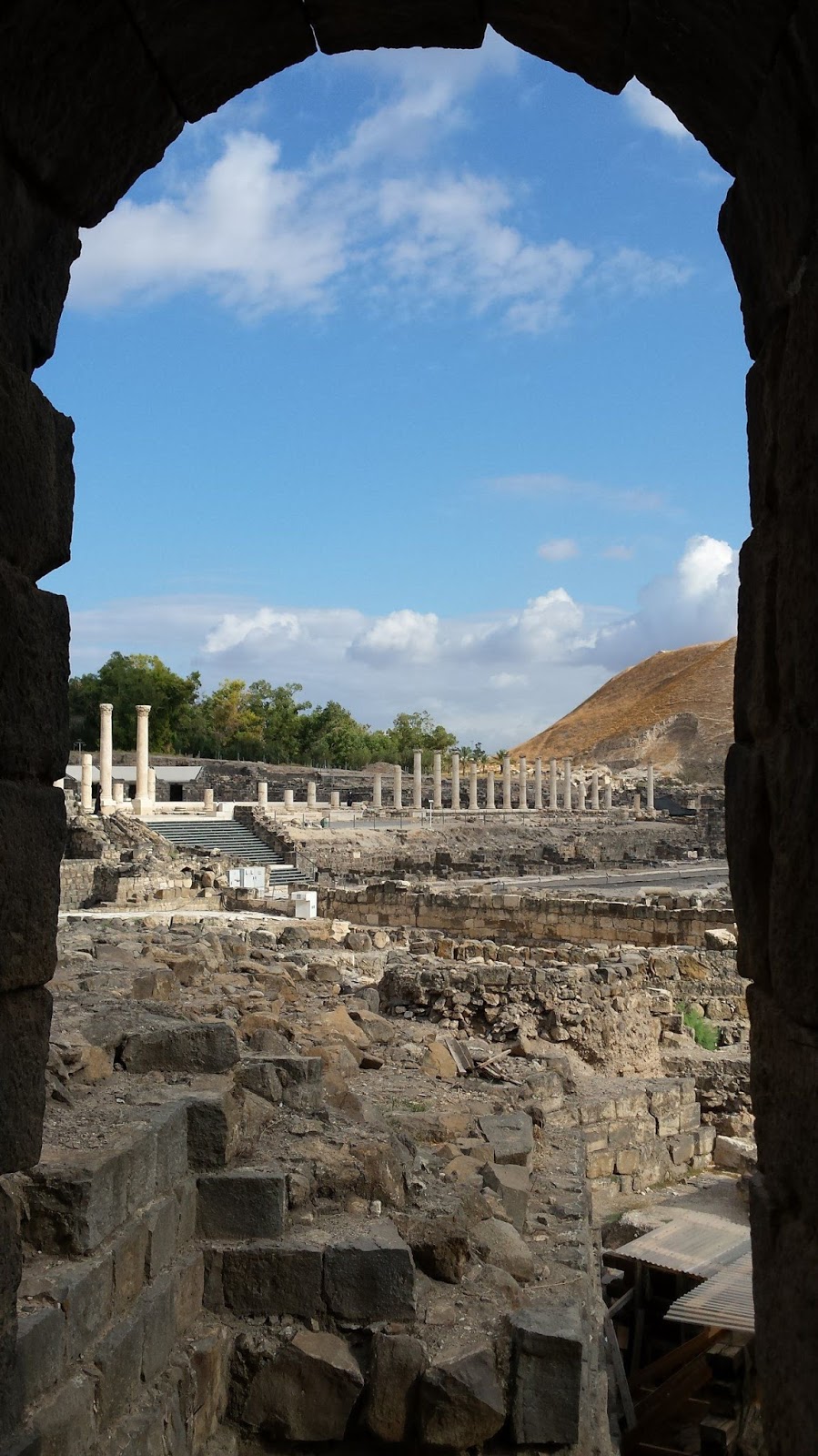
It's a set of  ruins about 45 minutes from the kibbutz where Betty and Doobie live. Excavations there indicate that settlement may date back to the Late Neolithic or the Early Chalcolithic age, a timeline that defies imagining. The city has been occupied by the Egyptians, Romans, Greeks, Crusaders, Mamluks, Ottomans and more. You simply must read the explanation contained in the link above, because I can't begin to scratch the surface of what the city has seen. 

The ruins themselves blew our minds. We thought they were massive, with areas of the "tel" (mountain) yet to be uncovered.

This was our first view of Beit She'an from the visitor center above. The "mountain" behind (the tel) contains ruins and artifacts yet to be uncovered. This does not begin to show the size of Beit She'an.
The fact that would strike us over and over with each succeeding set of ruins is the sheer size of each and the manpower it would have required to construct them. 

This is the road ("cardo" that led north-south through the city.
This was a portion of the caldarium, or baths. The floor would sit on these pillars,
and water would be poured around them to heat the bath area.
Beit She'an sits on a major earthquake fault, and the city was destroyed in the Golan earthquake of 749. Many of the fallen columns and other rubble date from that time.

Columns along the Cardo which have been re-erected
 
Detail of the capital, or top, of the column. 

A portion of the Decumanus (East-West Road), showing the earthquake's destruction.

I'll bet you'll never guess what this is . . .
Gila, our guide par-excellance, taught us everything, including how to use the latrine!
 I guess the Romans didn't believe in privacy.

Here's yet another view of Beit She'an, as we rounded the walkway approaching our exit from the site.


Beit She'an through an arch

The grounds of Beit She'an National Park are simply beautiful, with an area around the visitors center where families can sit in the shade of fig trees and grape arbors and relax as they contemplate the ancient past.


We had arrived at Beit She'an a few minutes before its scheduled opening, and we had to wait a bit for the caretaker to arrive and open it up. Gila had planned for an early morning because we had yet another adventure to undertake, and she wanted to tackle it as early as possible: our border crossing from Israel into Jordan.

Friday, November 4, 2016

Capernaum - The Home of St. Peter

Before we travel the short distance from the Mt. of Beatitudes to Capernaum, I should make a short disclaimer. The Mt. of Beatitudes is not a mountain, at least in my sense of the word. It's more like a small hill, albeit one with gorgeous views. 

As I think back to the Bible stories of my youth, I remember picturing the place of the Sermon on the Mount as  similar to the southern California mountains I grew up with, thronged with people listening to Jesus. The reality, beautiful as it is, is far different. 

Were I to consider moving to Israel, I would probably have to think twice. Mountains are essential. Never seeing the sea again? Not a big deal. No mountains? Nope. Maybe that's the draw calling me back to Alaska over and over.

These are MY mountains, and this is my backyard:


Looking into Yosemite's Tenaya Canyon, with Half Dome and Cloud's Rest looming above
But enough of mountains vs. MOUNTAINS. On to Capernaum.

The overriding sense of Israel is history. Layers of history. Masses of history upon more history. Pre-Christian era, Roman, Judean, Crusader, Bysantine, it's all in one place. The United States is such a young country, that it's hard to fathom what the land of Israel has seen.


Roman ruins at Capernaum


Remnants of synagogue beneath Christian church above at Capernaum

A flag with the Jerusalem Cross flies above Capernaum


A glimpse of the sea beyond the ruins

Statue of St. Peter
We finally hauled ourselves back onto the bus to complete a circuit around the Sea of Galilee and return to paradise . . . Ein Gev. As we rode, I called Betty. "What do you think about joining me for a glass of wine tonight?"

This was an impromptu idea, not scripted like much of our previous time both at Massada and during the Road Scholar program. After consulting with Doobie, she confirmed they'd come by.

I'm so thankful we acted upon impulse. None of us knew, then, that would be our last in-person meeting of the trip.

Thursday, November 3, 2016

The Sea of Galilee - on to the Mt of Beatitudes

A month after returning from Israel, I rue the decision not to take copious notes about our travels but to depend on names of places and my memory. I remember the feelings of being awed by every place we visited and marveling at each piece of art which had survived the centuries. It's the details that have fled the brain cells.

On Day 6, after leaving the Church of the Annunciation in Nazareth, we traveled through the Jezreel Valley around Mt Tabor, through Afula and back to the overlook that had I seen on my first day/hours in Israel--a repeat of my glorious first look at the Jordan Valley where my friends Doobie and Betty live.

A bit of an aside. A number of years ago a friend introduced me to Daniel Silva and his protagonist, Israeli spy-assasin-art restorer, Gabriel Allon. Silva writes one book a year, published each July, and I eagerly await each edition. It's pre-ordered through Amazon and downloaded the day of its release. Within three or four days, I'm twiddling my thumbs waiting for the NEXT book. I love the way Silva writes, his character development, his way with words and his ability to make scenes come alive.

According to the biography created by Silva, Gabriel was born and raised in the Jezreel Valley. I followed his footsteps as we traveled through the areas described in the multi-book series. 

Although the primary reason for the trip to Israel was to visit Doobie and Betty, a close second was to visit the land of Gabriel Allon. 

Those who have paid attention to recent news briefs may recognize the summit of Mt Tabor as the site of the Church of the Transfiguration which was recently vandalized.


The southern end of the Sea of Galilee (Kinneret), where I spent my first few days in Israel. This reprised the first view
I had of the Sea of  Galilee, Kibbutz Massada and the Golan Heights in the distance. I will always treasure this sight, and I long to see it again.
We had taken the "long way around" from Nazareth en route to Capernaum and the Mt of Beatitudes precisely because Gila wanted us to see this view. We descended to the valley floor and turned toward Tiberias, the largest city in the Jordan Valley and the source of the lights across the Kinneret the night before at Ein Gev. 

When I visited Betty and Doobie, they took me to Tiberias to experience a real "hole-in-the-wall" Israeli eatery. Crammed with people, noisy with Israeli voices, raucous with the clatter of silverware, I was overwhelmed--but not nearly as overwhelmed as when the platter of schwarma arrived. I became an instant fan. The "burrito" brimmed over with juicy, delicious meat and sauces, so much that I had to take fully half of it home to eat later. As we drove through Tiberias, I craned to glimpse the hole-in-wall again and wished I could savor another batch of schwarma or another taste of the kebab Betty had ordered. 

But we didn't stop. We traveled on to what Gila identified as the Mt. of Beatitudes, where Jesus gave the Sermon on the Mount and fed the multitudes. As we arrived, Gila told us that of all the sites we would visit on this tour, this was her very favorite, where she felt most at peace.

It was easy to see why. 

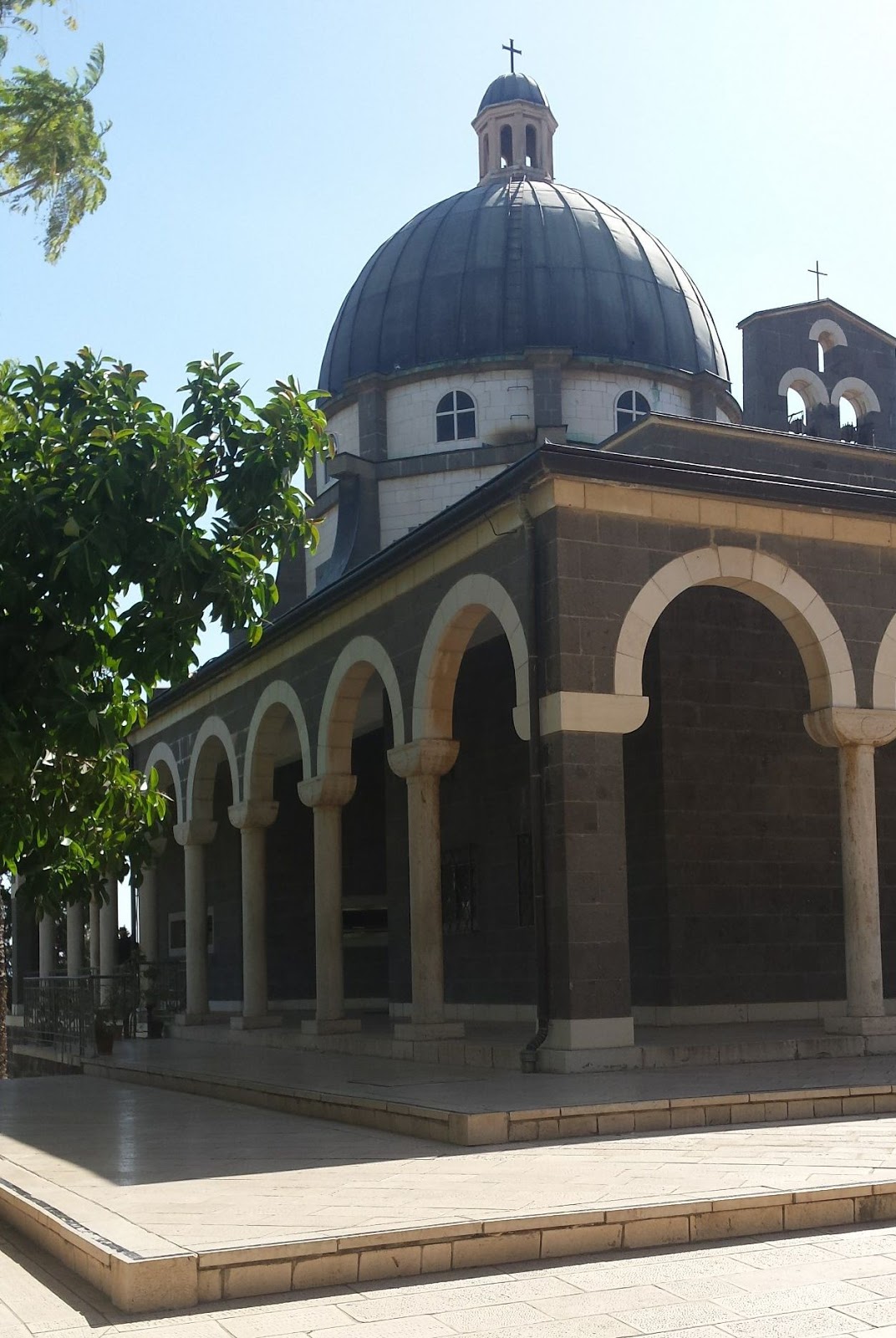
The site of the Mt. of Beatitudes is simply glorious with its view of the Kinneret and its manicured gardens.


Church on the Mount of Beatitudes
Magnificent altar inside the church
Mosaic gracing the church floor
Lovely gardens


I was there . . .
My favorite of all the views I captured at Mt. of Beatitudes
Our time at Mt. of Beatitudes went much too quickly, as happened at every spot we visited, but we had to make our way on to Capernaum, very close by, known as the home of St. Peter as well as the "town where Jesus walked."

That's the subject of our next post, coming up tomorrow (I hope).

Sunday, October 30, 2016

The Sea of Galilee - Redux: First Stop, Nazareth

Did you wonder where I've been? 

I've been beading. There's a holiday boutique at the end of next week for which I've signed up. That means having a supply of product ready to sell. I'm not quite there yet, but my hands feel the need to take a short break from the needle and thread.

My last post featured a very special birthday, which Betty, Doobie and I thoroughly enjoyed. The next morning the Road Scholar tour resumed full-force with visits to a number of well-known Christian sites.

The first stop, after a drive of about an hour, was the Arab town of Nazareth, where we visited the Church of the Annunciation.  

I found Nazareth to be charming, built on hillsides with the streets lined with merchants selling everything from trinkets to vegetables and fruits. I loved hearing  Arabic spoken, as I'd taken two years of the language in college, many, many years previously. All the remains of those two years are a few random phrases and the one sentence that I've never found useful:  "The teacher came, took roll and gave the lesson." Why I've remembered that so many years later I'll never figure out.

The church was beautiful, almost modern in appearance with its unusual "spire," although it dates back to Crusader and Bysantine times.


As we walked up to the entrance, I thought of another of my friends dating back to my college days:  Jenny, whose sons are named Matthew and Mark. As I was thinking of her, she was at home, at my house, caring for my precious animals.


Posted around the courtyard of the church is artwork donated by many countries. Most of them were truly lovely, a representation of the individual cultures.


Mexico

Poland

Czech


Most of these exhibits were truly beautiful. The only one lacking (in my opinion only) was the extremely contemporary exhibit provided by the United States, constructed from pieces of a space shuttle. I did not take a photo of this.

Inside the church, in a grotto on a lower level of the church is a site believed to be the original childhood home of Mary, mother of Jesus.

Mary's Grotto in the Church of the Annunciation,
Nazareth, said to be the location of the childhood home of Mary.

We took the opportunity to use the beautiful surroundings to take some personal photos.

New friends Linda and her daughter, Shelby, from Oregon.
I was there, too.


As we left the Church of the Annunciation, we got yet another lesson in the art of bus driving in Israel/Palestine. The narrow streets of Nazareth barely accommodated two-way traffic, let alone the huge tourist buses that seemed to be everywhere. As we waited half in the street for our bus, our expert driver, Mazen, skillfully threaded our bus around pedestrians, cars, brick walls and made a U-turn to pick us up. As he pulled up in a spot where buses weren't allowed, we scrambled aboard and headed out.


The Sea of Galilee - Redux: First Stop, Nazareth

Did you wonder where I've been? 

I've been beading. There's a holiday boutique at the end of next week for which I've signed up. That means having a supply of product ready to sell. I'm not quite there yet, but my hands feel the need to take a short break from the needle and thread.

My last post featured a very special birthday, which Betty, Doobie and I thoroughly enjoyed. The next morning the Road Scholar tour resumed full-force with visits to a number of well-known Christian sites.

The first stop, after a drive of about an hour, was the Arab town of Nazareth, where we visited the Church of the Annunciation.  

I found Nazareth to be charming, built on hillsides with the streets lined with merchants selling everything from trinkets to vegetables and fruits. I loved hearing  Arabic spoken, as I'd taken two years of the language in college, many, many years previously. All the remains of those two years are a few random phrases and the one sentence that I've never found useful:  "The teacher came, took roll and gave the lesson." Why I've remember that so many years later I'll never figure out.

The church was beautiful, almost modern in appearance with its unusual "spire," although it dates back to Crusader and Bysantine times.


As we walked up to the entrance, I thought of another of my friends dating back to my college days:  Jenny, whose sons are named Matthew and Mark. As I was thinking of her, she was at home, at my house, caring for my precious animals.


Posted around the courtyard of the church is artwork donated by many countries. Most of them were truly lovely, a representation of the individual cultures.


Mexico

Poland

Czech


Most of these exhibits were truly beautiful. The only one lacking (in my opinion only) was the extremely contemporary exhibit provided by the United States, constructed from pieces of a space shuttle. I did not take a photo of this.

Inside the church, in a grotto on a lower level of the church is a site believed to be the original childhood home of Mary, mother of Jesus.

Mary's Grotto in the Church of the Annunciation,
Nazareth, said to be the location of the childhood home of Mary.

We took the opportunity to use the beautiful surroundings to take some personal photos.

New friends Linda and her daughter, Shelby, from Oregon.
I was there, too.


As we left the Church of the Annunciation, we got yet another lesson in the art of bus driving in Israel/Palestine. The narrow streets of Nazareth barely accommodated two-way traffic, let alone the huge tourist buses that seemed to be everywhere. As we waited half in the street for our bus, our expert driver, Mazen, skillfully threaded our bus around pedestrians, cars, brick walls and made a U-turn to pick us up. As he pulled up in a spot where buses weren't allowed, we scrambled aboard and headed out.