Showing posts with label Khyber Dreams. Show all posts

Thursday, January 14, 2010

Khyber Dreams Chapter 16: Next Stop, Lahore

From Multan we traveled to another city in the Punjab:  Lahore. This is the second-largest city in Pakistan, and perhaps the richest in heritage. It is home to the Badshahi Mosque and the Shalimar Gardens, among its treasures. Much of Pakistan's most impressive art and literature has come from within its borders.

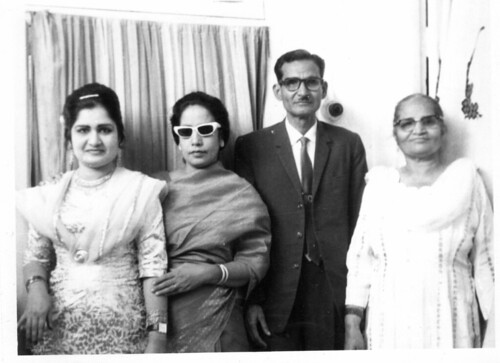
At left, we explored the Shalimar Gardens in company with my sister- and brother-in-law Jamilah and Iqbal, and SiL and BiL Safia and Nayyir.

Bhai Iqbal was the first of Abid's family ever met, when he came to the United States for a visit. In fact, it could well be that Iqbal's visit propelled us into making the trip to Pakistan. Abid was decidedly ambivalent about returning to Pakistan, especially not knowing how he would be received with an American wife. After his brother-in-law assured us that we would be quite welcome, we went ahead with our plans.

Needless to say, Iqbal was right.

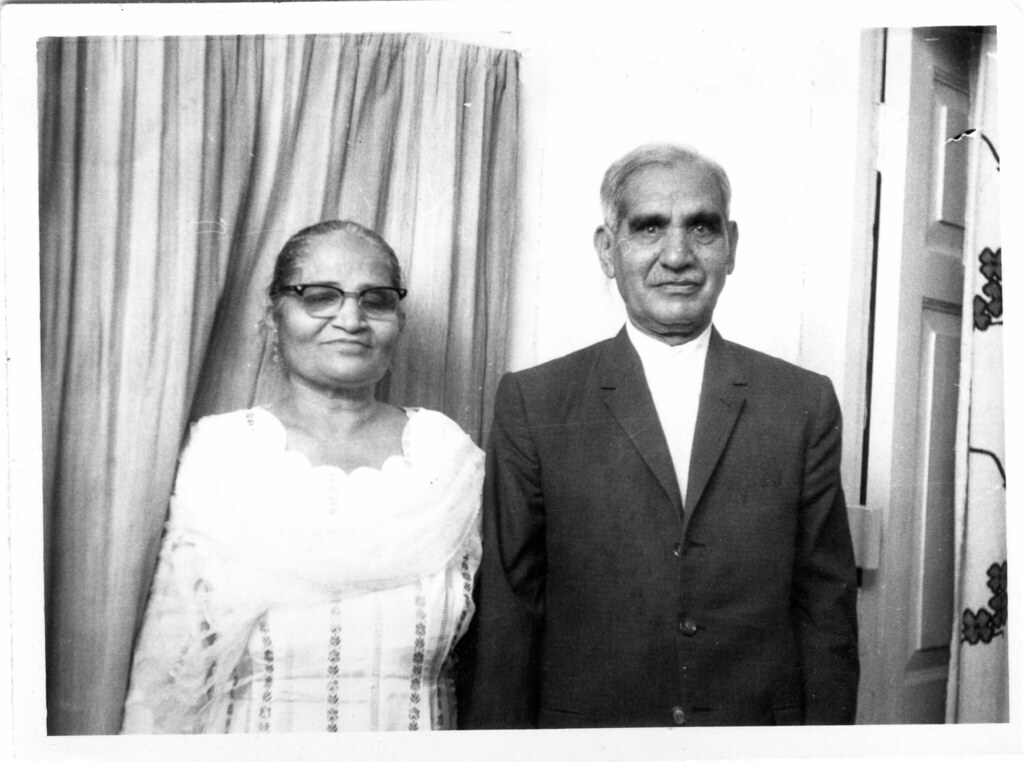
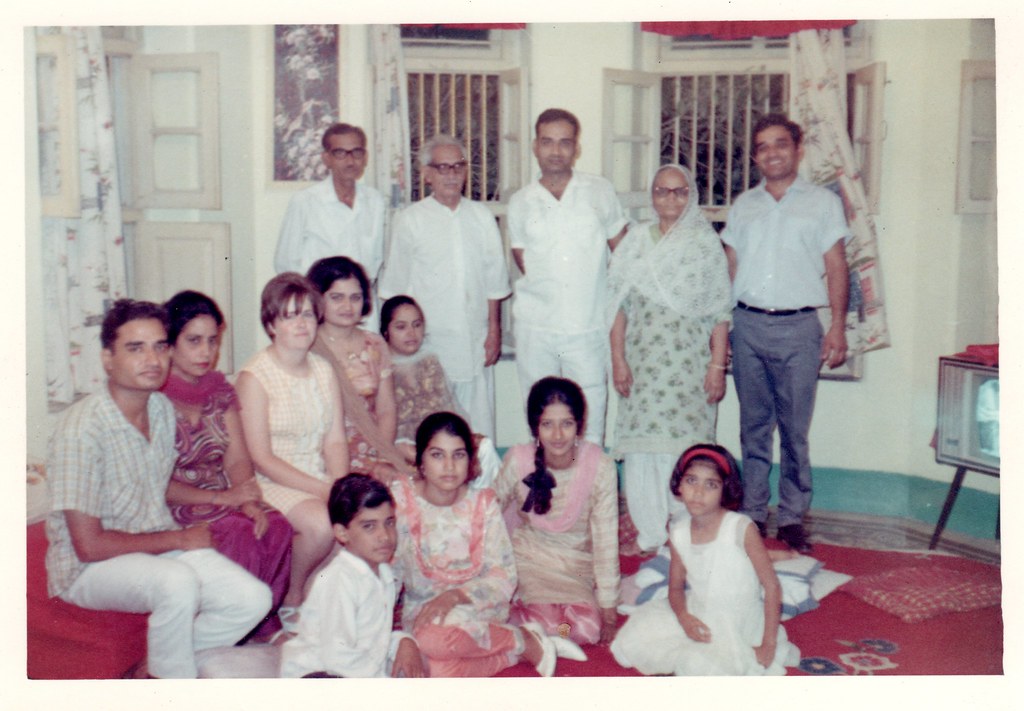
Abid's mother, sister Safia and husband Nayyir went with us to Lahore, and I'm sure his mom felt that she was returning to her roots. She had the opportunity to visit with Iqbal's mother (seated next to her in the bottom photo) and others of her generation that she didn't often get to see.

One of the most delightful memories I have of our Lahore visit was observing Iqbal's mother smoking the hookah, a common-enough practice in the "provinces," but I hadn't seen it in the city.


Photo at left:  me, Jamilah, her daughter Shahida, and Safia


Tuesday, January 12, 2010

Khyber Dreams Chapter 15: A Pakistani Game, of Sorts

Before arriving in Pakistan I could recognize one or two words in Urdu, the language of Pakistan, but that was about it. Abid's family set about trying to change that.

One of the great games played during our visit was "Teach Judi to Speak Urdu."  To me this was great fun because I've always been something of an amateur linguist, fascinated by the ins-and-outs and relationships between culture and language. My college degree is in Spanish, something that has proved useful from time to time on jobs I've held, including ECCO, but has never resulted in anything employable.

I also took four semesters of Arabic at Cal State LA, which ultimately resulted in my meeting Abid. One of my classmates, Sharon Mackay, became a great friend, and we're still in contact sporadically today. She's one of those amazingly-organized people who never forgets a birthday, and every year like clockwork I receive a card from her. Public apology to all my friends:  I'm sorry. I'm a nerd about birthdays, and if you receive a card from me it's a miracle. It's not that I don't love you--it's that I can't keep things like dates straight.

Where was I going with all this? Oh, yeah. At the time I met her, Sharon had a Pakistani boyfriend, Haider, who lived in Wilmington in a house owned by another Pakistani--Abid. We all started hanging out together. Sharon and Haider ended up married, although later they divorced. Of course, so did Abid and I.

Anywho, over the years, in my linguistic pursuits, I took two days of French, which I hated, and a summer session of German, which I loved. You can see that languages have been a long-term passion of mine.

All of this is to say that, when Abid's family tried to teach me Urdu, I was all over it. I wanted to learn. But Urdu, and its sister-language, Hindi, are not like any other languages I've ever studied.

Arabic, of course, has a completely different alphabet, written right to left, and sounds that don't exist in English. I still don't comprehend how I couldn't grasp the sounds of French and yet one of my Arabic professors, who hailed from Beiruit, once complimented me that my Arabic sounded like "a voice from home." To this day I can remember a sentence and a half of Arabic, in close-to-perfect pronunciation. The complete sentence is:   "The teacher came, gave the lesson and took roll." Very useful. The fragment is even more so. It is something like "There came from Damascus today news about the Palestine War something something Abd-ur-Rahmani something something . . . "

All of this indicated to me that I should at least be able to master a smattering of Urdu. Unfortunately that wasn't necessarily the case. Although Urdu contains many of the unusual Arabic sounds, it also has some unique unto itself and Hindi. (It should be noted here that Urdu and Hindi are related; a Hindi-speaker can understand Urdu and vice versa--it's just the old India vs Pakistan animosity that has them named differently, along with the natural changes that come with distance and a culture-in-change.)

I pride myself on being able to hear the nuances of language and to be able to pretty accurately reproduce them. Urdu escapes me. I can't even correctly pronounce the word  for tea (chai) to this day.

Still, I wanted to learn, and the family wanted to teach me. I did get to the point where I could understand some of what they said (and really enjoyed watching and listening to "Slumdog Millionaire" to see how much I could remember).

In Multan we spent a couple of evenings with Razia, her husband and kids trying to teach me a rather involved sentence about an airplane. I can't remember any of it now, but by the time we left I could say it well enough that they actually understood me.

What I did learn that proved useful over the months we stayed at Britto Road was the ability to ask for the keys for upstairs and downstairs. "Niche ki chabe chayye" and "Upper ki chabe chayye" ("May I have the downstairs key?," "May I have the upstairs key?")


My mother and father-in-law spoke no English at all. Since I spoke no Urdu, there was limited communication between us. But somehow we managed. One morning Abid came out of the bedroom, surprised to find my mother-in-law and me in animated conversation. She was talking a mile a minute, and I was nodding my head in agreement. Abid laughed.

"You didn't understand a word she said."

"Oh, yes, I did. She told me she was going to the market to buy some fresh vegetables."

He looked stunned. "That's right. How did you know?"

"I understood her."

Truthfully I didn't, but language is much, much more than words. She communicated to me, and I to her, by gestures, by body language, by looks, by those one or two tidbits I could pick up.

I think I gained just a little bit of respect that day from both my husand and my mother-in-law.

Sunday, January 10, 2010

Khyber Dreams Chapter 14: On to Multan


The first stop on our adventure to the outskirts of Pakistan was the city of Multan, where Abid's sister Razia lived with her family.  (Photo at left:  Me, Safia, Razia's children, Razia)

Multan is located in the Punjab area of Pakistan, close to the northeastern border with India--and relatively close to the city of Jalandhar, India, where Abid's parents had grown up, married and lived prior to Partition.

For those who might not be aware, Pakistan (both West and East--which is now Bangladesh) was a part of India as recently as 1947. That was the year the British departed and created in their wake the mess that was to become the political situation between the Hindu nation of India and the Muslim nation of East and West Pakistan. To make things even more interesting, they left the region known as Kashmir in dispute, and both nations have claimed it. That, as I understand it, is largely the basis for the animosity between the two nations today.

The area that became Pakistan was predominantly Muslim, so those Hindus residing within the newly-designated confines were obliged to move to India. Conversely the Muslims within the area designated as Indian were forced to pick up and move to Pakistan. That was the case with Abid's parents, who resettled themselves in the port city of Karachi. I'm not sure which of the ten were born after their move, but Abid was, as well as the younger brothers Akhlaq and Munnawar.


Truthfully I can't remember a lot about our visit to Multan. Something I remember vividly, however, is the mosque adjacent to the house where Razia's family lived. This wouldn't have been a problem except that the muezzin calls the faithful to prayer five times a day, beginning at dawn. And he doesn't do so quietly.

That first morning (at somewhere around 5:00 am) I shot straight out of bed as if I'd been shot.

"What the blazes is THAT?"

I knew full well what it was, having listened to it many times in Karachi, just not at ear-splitting volume since the mosque was at something of a distance from Britto Road.

The muezzin's call to prayer is loudly amplified so that all can hear it, much like a rock concert. Since the awful day of 9/11, the opening words of the call to prayer have become frightenly familiar to western ears:  Allahu Akbar!  (God is great!) The Arabic language of the Qur'an is hauntingly beautiful, and I love to hear it spoken. But it has become disgustingly associated with the terrorist element of the religion. That makes me very sad.

The photo above shows the mosque in question, from, I believe, the roof of Razia's house. It doesn't look so close in this picture. It felt like the muezzin was right in the next room, however, when he did his "performance" every day, five times a day.

Wednesday, January 6, 2010

Khyber Dreams Chapter 13: Party Time

Even though I was sicker'n'a dog, life in Karachi went on. It's no doubt that our visit there sparked a lot of curiosity amongst Abid's hundreds of relatives. Even more than that, the family was most anxious to show us how much they loved us. My memories have faded about the finer details of the party they planned for us (specifically for Farida), but it was so special that I have to share what I do remember.

It is the custom in Pakistan to host a party on or around a child's second birthday. If I recall correctly, it is also the occasion of the child's first haircut. Although Farida wouldn't turn two until after our departure, Abid's parents wanted to honor her in advance. It also served as an opportunity to invite those relatives twice and three-times removed to meet us.


I was down for the count, but I wasn't needed to help in any case. The Britto Road crew moved into high gear, inviting everyone and getting the food prepared. In this particular case the food included a live goat which had to be freshly-slaughtered by a mullah according to Islamic tradition then cooked into a curry. This was not something that my delicate sensibilities appreciated, so when they brought the goat around, I made myself scarce and took pains that my ears were covered.

The family began to prepare massive amounts of biriyani and raita and other delicacies, including the one Middle Eastern food group I can't abide:  dessert. I'm sure for those who know me, this is a real surprise. For most people, a dish of baklavah is a treasure. I can barely look at it, let alone eat it. I also can't stand gulab jaman, halva or kheer. The one exception is seviya, a vermicelli pudding laced with almonds and pistachios and decorated with gold or paper foil. Really. Although at that time I couldn't stomach even that.

You can imagine that the smells of all this wonderfulness were overpowering, especially for someone who hadn't eaten more than a tablespoon of food in weeks. Literally. One of the relatives who decided that a dish of kheer would be mild enough for my battered stomach brought me some and suggested I give it a try. I couldn't refuse, but one bite was all it took for me to become violently ill.

I spent the rest of the party in the bedroom in a desperate attempt to hold things together.

Prior to my hasty exit, I did spend some time with the family, as shown in the photos below. In the first picture, you'll see me at the extreme left. Look to the very bottom picture to see the wedding finery in which I'd dressed. It thrilled the family to have Abid and me celebrate a "mock" wedding at every possible occasion.


Do you notice anything unusual about the upper two photos? (I know they're very fuzzy--hey, they're 40 years old and scanned from paper originals.) Let me know what you see that makes this different from the typical United States soiree.

Saturday, January 2, 2010

Khyber Dreams Chapter 11: Pakistani Cuisine

One element of Pakistani life that required no adjustment on my part was the food. I'd  been eating and enjoying it since Abid and I first started going out, and I loved the opportunity to sample the "real thing."

My mom and dad were devotees of the solid midwestern meat-potatoes-salad-vegetable type of meal, and that's really all I knew until I met Abid and his friends. In my family we ate beef and poultry. Period. My dad wouldn't eat lamb, and he would rarely eat fish.

It's been my experience that most people who don't grow up with it have somewhat of a learning curve with curry. First off, most westerners have the mistaken impression that curry is a single spice, the kind that's sold in the story labeled "curry powder." Not true at all. A true curry, properly made, is a combination of spices and herbs that are mixed together only at the moment of dish preparation. The actual combination depends on the type of dish being constructed.

Abid and his roommates, all Pakistanis or Indians, prepared their versions of food from their homeland, and whenever you'd enter their house, the air was filled with the distinctive scent of Indian cooking. Many people don't care for it, but I loved it from the first.

I learned both to eat and cook various dishes, although I've never come close to mastering its preparation as my sister-in-law Safia has. Over the years, as I've eaten less and less Pakistani cuisine, my ability to create it has also diminished--but not my love for it. Luckily roommate Carol relishes Indian cooking, as well, so we do seek it out on occasion. In all these years I've never come across a restaurant whose culinary skills are a match for Abid's family's.

Because meat is a luxury in India and Pakistan, many recipes are principally vegetable-based, with rice a main course and meat an add-on. One of the most popular and familiar dishes is a lentil soup called dhal. There are many varieties, and in my opinion, all are delicious. This is considered a poor-man's food, so it's not normally served for guests, but I would be happy eating it at any time.

During the time I was in Pakistan, the ultimate meat served for special occasions was chicken. Because everywhere we went during our time in the old country, we encountered chicken at nearly every dinner.

Thinking about it later I had to laugh. In 1979 my mom and I took Farida and Nasreen on a journey to Oklahoma, Nebraska and Wyoming to visit our relatives. This time it wasn't chicken at every meal: it was HAM.

Thursday, December 31, 2009

Khyber Dreams Chapter 10: Feeling Better

What a miracle!

A day after I collapsed in a heap, barely able to move, I was feeling remarkably better.

I got up and had breakfast with the family, although I limited myself to the blandest of foods:  a little egg, a little chappati. Although I thought the worst was over, there was no way I was going to take any chances that there would be a relapse. Besides, I still felt weak. Whatever stamina I'd possessed before falling ill had departed for parts unknown.

We'd begun to make plans for our travels to other parts of Pakistan to see Abid's sisters who lived in the provinces:

We also planned to visit Abid's auntie in Rawalpindi.

I dearly hoped that my bout with the flu had ended so that I could enjoy seeing these historic places and getting to meet the rest of Abid's family.

Tuesday, December 29, 2009

Khyber Dreams Chapter 9: A Little Bug

Aside from the afternoons spent trying to get Farida to take a nap, life in Pakistan was good. Abid and his brothers showed me much of the city where they'd grown up.

We stared at the snake charmers at Hawkes Bay, and took a camel ride. We went out to Clifton, one of the ritziest residential communities in Karachi, which would later become famous as the home of Benazir Bhutto's family.

Although I confess I never really got used to the weather, all in all I got along well.

That is, until I got The Bug.

One morning I woke up and felt like someone had hit me over the head with a massive sledgehammer. I was listless, feverish and nauseated. When Abid's mother called us for breakfast, I said, "not for me. I'll pass." I couldn't move. It was all I could do to take care of necessities, especially under the rather primitive conditions of Britto Road.

I assumed I had the flu, and in a couple of days I'd feel fine again. Abid's family pretty much thought so, too. I spent that day in bed, getting up only when I absolutely had to. I can't honestly remember who took care of Farida--whether she stayed with me or whether Abid took her.

Suddenly I was not having any fun at all.

Saturday, December 26, 2009

Khyber Dreams Chapter 8: It's Not Fair!

August in Karachi is HOT. And humid. Both at the same time. The weather there is decidedly uncomfortable, especially for those of us born and raised in the temperate southern California climate. Abid, who lived in Karachi until the age of 20, also found it pretty miserable. Unlike me, he had an "out."

In the house on Britto Road, one room (and one only) was air conditioned. After our afternoon meal (and much like Mexican custom, the main meal of the day is in the early afternoon), he and his brothers would retire to that refrigerated room, close the door and talk, snooze or whatever.

Farida and I, on the other hand, would swelter in the excessive heat of our bedroom while I'd coerce her to go to sleep. Farida has never been a sleeper. From the time she came home from the hospital, she's subscribed to the rule that daylight is for having the eyes open. Even now she's likely to be up and awake at 5:00 a.m. The big difference is that she's apt to fall asleep earlier in the evening than she did as a 1-1/2-year-old. Usually after an hour or so of both of us trying to find a way to get comfortable in the oppressive heat, she'd fall asleep for a half-hour or an hour.

I have to admit that Abid's family would have gladly taken Farida off my hands for an hour or two or twenty during our stay, but she would have none of it. She refused to go with anyone except Abid or me the entire time we were in Pakistan. And because she wouldn't go to sleep without an argument, we were pretty much banished from the climate-controlled room each afternoon.

Did Abid ever once offer to spell me on the nap time? Of course not, because:
  1. He couldn't stand the heat
  2. He's a guy
  3. It's not a manly thing to do
  4. He wanted to visit with his brothers
All of those things probably made perfect sense to him, but it was exceedingly difficult for me. Life in Pakistan required lots of adjustments for this western-born female. Most of them were doable, but this one was something I never could accept (although I couldn't see that I had a choice, at that time).

And it got worse after I got bit by the bug.

Thursday, December 24, 2009

Khyber Dreams Chapter 7: Major Surgery

When I arrived in Pakistan, I was 26 years old and probably one of the only persons on the planet who didn't have pierced ears. Oh, I'd wanted them for years, but the idea that I could cheerfully allow someone to poke a hole in a part of my head was way beyond my comfort zone.

I'd tried to muster the courage when I lived in Mexico City one summer. Made the appointment and everything. Got one of my friends to agree to take me. Even had the earrings I'd wear while the ear healed. And I chickened out. At that time I was 21. Five years later my fear hadn't abated.

In Pakistan a woman's wealth is often measured in how much gold jewelry she possesses, and Abid's family dearly wanted to give me earrings and necklaces to go with the new wardrobe they'd provided. Ears of women in the old country are pierced when they are infants or toddlers, and even the cheap cosmetic jewelry available there is only made for pierced ears. Consequently both Abid and my sisters-in-law tried to talk me into having the procedure done.

In brother-in-law Tajammul's family nearly everyone is a doctor. They own a multitude of hospitals in the Karachi area, so Abid approached Tajammul's wife, Aijaz, with an idea.

"Why don't you pierce Judi's ears in the hospital? Maybe she'll feel more comfortable that way."

I wasn't at all sure that was true, but Aijaz agreed with Abid that it was such a simple procedure and would take less than a minute.

They were going to give us a tour of their newest hospital anyway, so I decided to give in.

To my surprise Aijaz scheduled the "operation" to take place in the operating theatre. She brought me in and positioned me on the table then stepped outside for a moment. When she returned another woman was with her.

"Judi, I'd like you to meet Dr. (I can't remember her name). I've asked her to help me decide where to place the holes in your ears."

The two women conferred, studying each ear carefully, then Aijaz placed a mark on each one. They stepped back together and studied their handiwork--artists examining a freshly-painted canvas. Satisfied, Aijaz swabbed the first ear and prepared to proceed. I wondered if it was too late to jump and run. But I didn't. Aijaz took up her chosen instrument, poised over the ear and jabbed. A brief moment of discomfort and the deed was done. She came around to the other side of the table and repeated the procedure. In less than two minutes the ears had been pierced and the earrings inserted. There had been no pain.

Yes, I was embarrassed at my irrationality. I was even more embarrassed when I later learned that the woman who had consulted with Aijaz was a reknowned OB-Gyn whom Pakistani women waited months to see. She'd abandoned her patients for a couple of minutes--to observe the woman who was so frightened she had to have her ears pierced on an operating table.

Monday, December 21, 2009

Khyber Dreams Chapter 6: The "Homeboys" & A New Wardrobe

I can't believe it's been since September since I've shared a chapter of "Khyber Dreams" with you. For those who might have just arrived, this is the story of a western woman's journey to Pakistan many years ago as a relatively new wife with her Pakistani husband and 1-1/2-year-old daughter. It's the tale of my adjustment to a vastly different culture and a huge new family.

When we left off, Abid, Farida and I had just arrived in Karachi, and I was getting acquainted with Abid's family members.

The youngest three brothers (of a family of ten children) still lived at home on Britto Road with their parents. Akhlaq was married, so his wife and infant daughter were there, too. The other two, Akhlaq and Munawwar, were unmarried. They had both completed university and worked as scientists--one at a cosmetic company and the other at a pharmaceutical plant.

All of the family members in Karachi made it a point to ensure our visit was as comfortable as possible. They went out of their way to provide everything they thought we needed. Everything from medical supplies to a complete new wardrobe for me and a shirt or two for Abid.

Once we'd managed to get a grip on our jet lag, Abid's brothers began to take us out to explore the city where they'd all grown up. They wanted to show me as much as they possibly could. But it was painfully obvious from the first that a young woman in western clothes made quite a spectacle in the streets of Pakistan's largest city. I got stares wherever I went, particularly if I wore a dress where my legs were on display.

In this Muslim country women were expected to dress modestly, and that meant "covered up." And "covered up" could mean anything from shalwar kameez to a burqa. And the burqa itself could range from the black robe-like head-to-toe garment seen in the larger cities (where the head would be covered but all or a portion of the face might be visible) to the all-encompassing burqa of the frontier provinces where women were completely covered in a heavy garment with a "grille" for the eyes. Abid called these "walking tents." These are what are often seen in photos taken of Afghani women. I can't imagine wearing one of these in a country where the summer temperatures can regularly approach 120 degrees.

Abid's family were well-educated and quite liberated as Pakistani society went in those days. His sisters did not wear burqa under normal circumstances. There were, however, circumstances where even they felt more comfortable in the burqa, such as trips to the doctor.

Needless to say, once it became clear that I was attracting unwanted attention, I spoke with my sisters-in-law and asked them to help me obtain Pakistani clothing. I didn't have to ask twice. They were all over the task of outfitting me in the latest styles that would help me to fit in. Within days I had a complete new wardrobe. It made a world of difference when we went shopping in Soldier's Bazaar, for example, or visited other public places. Although my fair skin, hair and eyes clearly marked me as a Westerner, I didn't feel as though I was on display.

Shalwar kameez (or pyjama kameez) are the third-world version of pant suits and are supremely comfortable, and I actually enjoyed wearing them. (Explanation:  shalwar are "blousy," loose-fitting pants with a cuff at the ankle; pyjama are pants that are closely fitted to the leg, closely resembling western attire. Kameez is the word for a loose-fitting shirt which falls to somewhere between just above the knee to mid-calf.)

A dupatta, which completed the outfit, was decidedly NOT comfortable. A long scarf which was used to cover the hair when modesty was required, most of the time the dupatta was draped with the middle portion across the chest and shoulders, the ends hanging down the back. I never could figure out how to keep it from falling off.

In the photo above, taken at Lahore's Shalimar Gardens, I am wearing shalwar kameez, with a dupatta draped across the shoulders, as is my SIL Jamilah, at left. Safia, in red, wears the traditional sari.
 
But the dupatta was nothing compared to wearing a sari. The sari has to be one of the most beautiful garments a woman can wear, but it takes talent to wrap it--and luck to keep it properly arranged. (If you happen to catch the hem on something or accidentally step on it, you could possibly find yourself unwinding your clothing!)

The sari consists of yards and yards of a light fabric, such as chiffon, which is wound around the waist, tucked into a petticoat with the loose end draped over the shoulder. A short blouse, usually baring the midriff, completes the outfit. I never really learned to properly wrap the sari myself and had to have one of my sisters-in-law assist me. God help me if I had to "use the facilities" because it was nearly impossible to lift up those yards and yards of material and keep them from getting soiled. I tried to make sure to take care of "contingencies" if I'd be wearing a sari for any length of time.

Because Abid and I were not married in Pakistan, it became a well-loved family activity to have us get dressed up in typical wedding garb, so they could take photos of us. This happened in virtually every city we visited.


Above:  Sister-in-law Jamilah, Abid, me, sister-in-law Safia, niece Shahida and her younger sister, dressed in wedding finery. In India and Pakistan, either red or green are the colors associated with wedding dresses.

In spite of the inconvenience, I'd challenge any woman to not feel her most feminine while wearing a sari.

Although I know Abid was secretly proud that his family had treated me so royally, he often joked that his family treated me like royalty while virtually ignoring him.

Actually that was true!

Tuesday, September 15, 2009

Khyber Dreams: Chapter 5 - Keeping 'em Straight

Notes to readers:  I have included links to terms and places that you might not be familiar with, in case you want to learn more about them.

Any details or customs I relate reflect my experiences and my knowledge at the time I was in Pakistan, in 1968. I confess that memories have faded and some details are not as sharp as I'd like. I tell the story as accurately as I possibly can given the 41 years that have elapsed.

As I introduce members of Abid's family, I should let you know that it is not customary to call relatives, particularly older relatives, simply by their first names. Brothers would be addressed as "bhai" and sisters as "bhabi," as marks of respect, for example, "bhai Tajammul" and "bhabi Aijaz." I have eliminated those titles in this narrative, but the respect remains, all the same.
***
 Abid comes from a family of ten children:  four sisters and six brothers, not to mention an unbelievable amount of aunts, uncles, nieces, nephews and cousins. I'd been hearing about all the brothers and sisters before we left the States. Now it was time to put faces to names and hope to heck I could keep them all straight.

Luckily I didn't have to learn all nine at once. Three of his sisters and their families lived in outlying towns, so I would meet Jamilah in Lahore, Razia in Multan and Taj in Peshawar later in our stay.

Of course, I'd met Abid's sister, Safia, as soon as we reached Britto Road. I'll write much more about her later because, of all the family members, I probably became closest to her over the months we stayed in Pakistan and throughout the balance of my marriage. She and her husband, Nayyir, even attended Farida's wedding in 2001, after I separated from Abid and moved to Bass Lake. 

That left the brothers:


  • Akhtar, the oldest. This picture is of sister Safia, Akhtar's wife (whose name I don't remember), Akhtar, and his mother. I can't remember ever visiting his home. He'd always come to visit us at his mother's home.


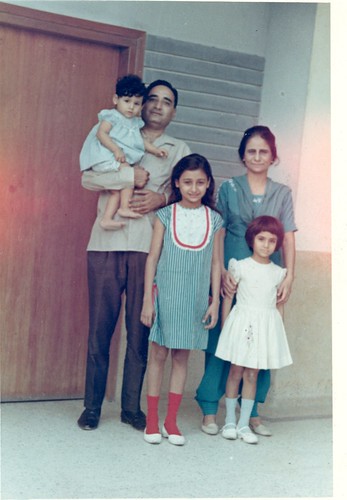
  • Tajammul, who is a doctor and the owner of several hospitals in the Karachi area. He married Aijaz, who is also a doctor. She is the daughter of Dr.Sir Ziauddin Ahmed, a prominent, well-respected physician and educator, for whom Tajammul and Aijaz named their first hospital and the teaching university the family operates. They raised four children, Asim (not in the photo) and Rubina (here standing between her mother and father), who are also doctors and well-known in their fields. As you can see, they were children at the time Abid and I visited. Sabina (in front of Aijaz) and Arif (in arms) are the youngest of their children.
Although Akhtar was the oldest brother, Tajammul would be the person the entire family turned to whenever there was a need. He was the acting patriarch of the family and became its de facto head upon the death of their father.

At the time of our arrival in Karachi, Tajammul and Aijaz were in the process of building a new residence in the suburb of North Nazimabad, a new development where some of the most prosperous Pakistani citizens of that era lived. The home was large, open and airy, two stories, with a spiral staircase connecting the floors. When complete, it would be a house to rival United States mansions. That wouldn't happen for a long time.


Construction in Pakistan takes place over years, not months, so the house was nowhere near complete when we first saw it. A rudimentary kitchen had been installed upstairs in what would later become a bedroom as the  modern, efficient "official" kitchen took shape downstairs. The servants  prepared meals upstairs, carried them downstairs to serve and then transported dishes and utensils back upstairs to be washed. It was not an easy process, made more challenging by the work schedules both Tajammul and Aijaz observed. It seemed like there was never a time of day when one meal or another wasn't fin preparation.

The situation would probably have been unbearable if it hadn't been for the quiet, moderating temperaments of both Tajammul and Aijaz. They brought calm to what would otherwise have been a tempestuous existence.


As I recall, the downstairs kitchen finally became serviceable shortly before our departure.

No matter the chaos that sometimes reigned over Tajammul's house, it was always a haven for us, particularly during the last month of our stay.  And best of all, it had western plumbing.


Next Episode:  The Homeboys

Sunday, September 13, 2009

Khyber Dreams: Chapter 4 - An Intro to Pakistani Life

I was completely blown away by the welcome Abid, Farida and I received when we arrived at Abid's childhood home on Britto Road. His parents lived there, along with Abid's brother Altaf and Altaf's wife and baby and Abid's two younger brothers, Akhlaq and Munawwar.

During the years Abid and I had been married I'd learned a bit about Pakistani customs. I knew that Pakistani elders depended on their children and grandchildren to take care of them as they aged. In the Pakistani version of Social Security, it was (and is) completely normal for adult children (and their children) to share a home with elders. Abid's parents appeared to be in their late 70's and slowing down. Having their children around allowed them to continue to live in the home they'd occupied for many years. In addition Abid's sister Safia, who had her own home with her husband in the area known as Defense Society, came to her mother's home daily to make sure everything was okay. She would help prepare the food and take some meals with them.

While we "Americans" often prided ourselves on our acceptance of other ethnicities, I'm embarrassed to admit that my own family had not been welcoming to Abid. To the day she died, my mother never completely accepted him, although she cherished her two granddaughters. Here his family was, opening their arms to me and greeting Abid as if he'd never been away. I honestly had not expected that, and I was grateful.

As soon as we'd lugged our suitcases upstairs to the living space, Abid and Safia gave me a tour of the house. I was struck by how similarly it was arranged to Mexico City houses I'd lived in. Built in a square with a large open area in the middle, the various rooms all opened onto the two-story-deep central "courtyard."

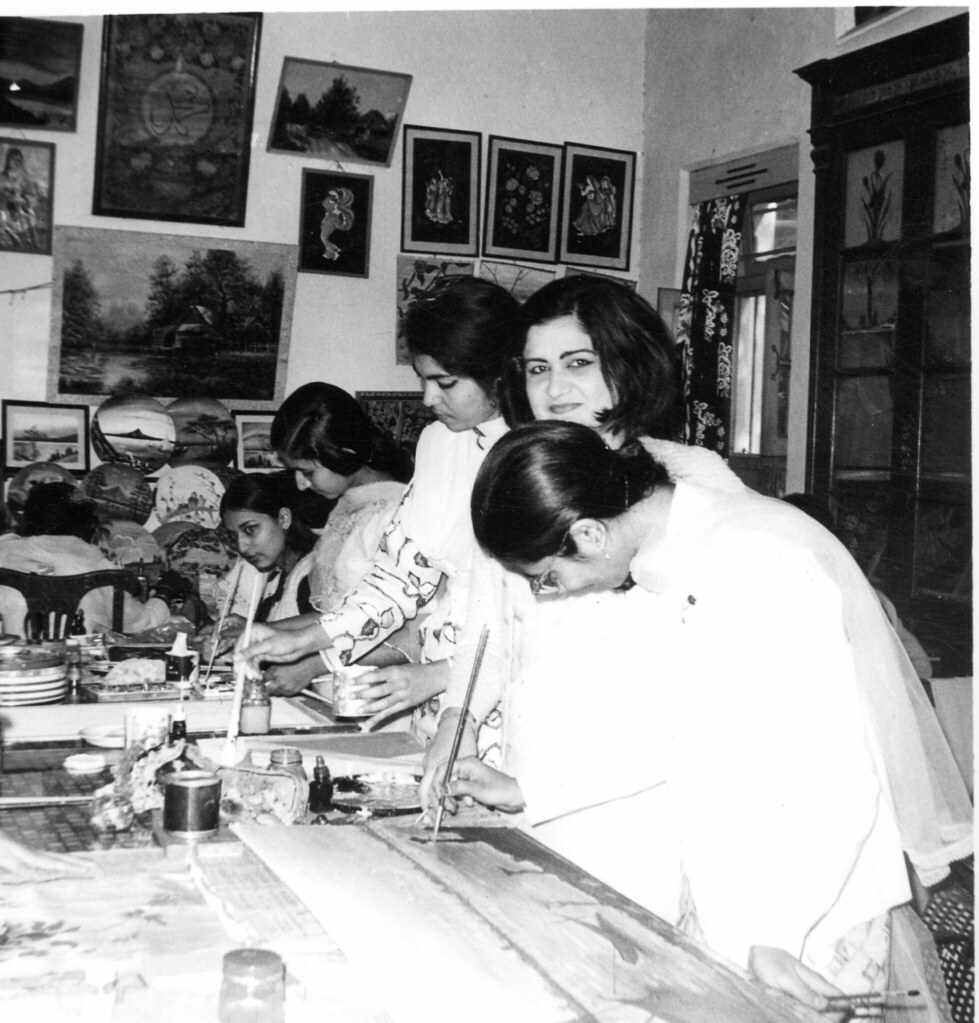
The rooms were large, the walls thick and stuccoed (very like southwestern adobes) to insulate against the heat and encourage air flow in a country where temperatures regularly reached into the 90's and beyond . . . with 90% humidity. As I remember, there was a living area, a kitchen, another living area which Safia used as a painting studio, a bedroom where Abid, Farida and I parked our stuff, another small bedroom, which was the only air-conditioned space in the house.

After all these years I can't remember where Abid's parents slept. I suspect the bedroom they assigned to us was theirs and that they probably slept on pallets in the living area during our stay. They were always awake before me during our entire stay, so I can't say for sure.

Abid rushed to show me the bedroom he occupied before he left for the States, atop the roof of the house and accessed by a set of rickety stairs. For years he'd told me about it.

An accomplished athlete, Abid loved competing at cricket, soccer and bicycle races. His parents, however, saw no value in sports and forbade him to participate in anything not having to do with book learning. The rooftop room allowed him to escape whenever he wanted by shinnying down the mango tree that hugged the side of the house. Even if his parents discovered his absence, they couldn't do anything about it until he returned. They'd chastise him, he'd listen--and do it all over again.

One area I remember vividly is the bathroom. And I use the term "bathroom" advisedly. Although I'm sure sanitary facilities have changed over the past 40 years, in many homes of that time, the "toilet" was an old-fashioned  hole in the ground. I hadn't known about this in advance, so it took a few moments (!) to get my mind around the facilities. I've never been known for my coordination, so the prospect of having to squat on my haunches was a bit daunting.  I adjusted, however, although I never liked it and never accomplished it with any grace.

Both Abid's sister Safia and brother Tajammul had recently built or remodeled their houses prior to our arrival and both included western bathroom facilities in their construction. I swear they timed the building to coincide with our visit. That's how accommodating they were to this complete stranger. Although Tajammul's house hadn't been fully completed by our arrival, he and his family made sure it was most comfortable when we visited or stayed there.

As a concession to my western sensibilities the family provided toilet paper for my use. The usual way of cleaning oneself was by use of a water pitcher. (I'll leave it to your imagination as to how that works.) That's a big reason why you won't see Pakistanis eating with their left hands . . . the left hand is for cleaning, the right is for eating.

The shower occupied a tiny room next to the toilet. I can't remember how or if the water was heated. Karachi weather was hot and clammy, so a hot shower probably was not necessary and not desired. In fact,  as soon as I'd exit the shower, the stifling humidity made me crave another. I never felt really clean for more than a minute during my entire time there, except during our visit in Peshawar toward the end of our stay.

I came to admire the agility of Pakistani women (and men) who could sit on their haunches as they worked, whether it was cleaning or cooking. Each morning Abid's mother would squat for an hour as she prepared chapattis from scratch and cooked them over what in Mexico was called a comal, a flat piece of metal or cast iron set over an open fire.I have no idea what it was called in Urdu, the language of Pakistan.

Perhaps the trickiest part of my earliest days in Karachi was figuring out who was who in Abid's family. He is one of ten children, and all of them except for three sisters lived in Karachi. A parade of brothers and their families appeared over the next few hours, anxious to welcome Abid home and meet his family.


Next episode:  Keeping 'em straight

Wednesday, September 9, 2009

Khyber Dreams: Chapter 3 - Family Ties


Abid's parents couldn't have been more welcoming. Everyone there, including Altaf's wife and baby, Abid's sister Safia and the students who came to the Britto Road house two or three times a week to study oil painting with her gathered around, anxious to meet the returning brother and glimpse the American wife and baby daughter.
Another hurdle overcome.

I began to relax a little.
Farida, on the other hand, screamed at the approach of anyone other than Abid and me. She adamantly refused to consider getting to know any of her Pakistani relatives. To her, of course, they were completely foreign. She didn't understand a word they said (even though many spoke excellent English), and she didn't recognize the saris and shalwar kameezes  the women wore.
That hurdle would hold fast the entire three months we remained in Pakistan. Pakistanis adore children, and I sympathized with Abid's relatives who wanted nothing more than to hold and cuddle her--not to mention I was aching for a break from the constant child care.

Group photo:  The family gathered at Abid's parents' house on Britto Road, shortly after our arrival. I'm surprised the photo reproduced as well as it did, being 41 years old and not stored under the best of conditions.


Standing, from left:  Abid's oldest brother Akhtar, Abid's father, brother Altaf, mother, Abid.   
                               
Middle row, seated, from left:  brother Munawwar, Akhtar's wife, me, sister Safia, (unknown).

Seated in front are Akhtar's children, I believe.


If I look tired, it's because I was . . . Pakistan is 12 hours ahead of California and a whole world away. It took at least a week before Abid, Farida and I didn't wake up in the middle of the night expecting to see the sun shining. That was my first experience with jet lag. Although I'd spent a lot of time in Mexico, Mexico City wasn't enough of a time change to be uncomfortable.


Not only that, but going from being an only child into a family of ten brothers and sisters--not to mention hundreds of cousins, uncles and aunties--required a huge mental adjustment. There was never a time when the house was empty of people, and that was a togetherness I simply wasn't used to.


To be continued. Next episode:  An Intro to Pakistani Life

Tuesday, September 8, 2009

Khyber Dreams: Chapter 2 - Welcome Home

Abid lifted the camera high over his head, prepared to slam it into the floor of the customs room after the agent on duty demanded he hand it over. Suddenly another officer burst through the double doors which led to the passenger greeting area, placed his hand on the examining agent's arm and whispered in his ear.

Turning to Abid, he apologized. "I am so sorry for this inconvenience," the obviously-senior officer said. "Please come with me."

Abid lowered the camera as the junior agent hurriedly stuffed everything back into our suitcases and shut them.

As we exited to the waiting room, Abid searched for familiar faces. By that time I was exhausted, and I honestly don't remember who met us, but I suspect it was Abid's brother, Altaf. Whoever it was welcomed us, hugged his brother, greeted me warmly and led us to the waiting vehicle. I sighed in relief. One relative down, hundreds to go.

The first thing I remember upon stepping out of the airplane was the overwhelming smell of diesel fuel. That odor followed me the entire time I was in Pakistan. Before that time a diesel smell evoked pleasant memories from my time in Mexico City. In Karachi, the scent invaded everything, even inside residences and businesses, because taxis and buses spewed smoke out their tail pipes, accompanied by the ever-present sound of motorized rickshaws.

Traffic in Karachi resembled that of Mexico City, only worse. Although stop signs and traffic signals marked the intersections, they seemed to be ignored by everyone. Defensive driving took on a whole new meaning as we careened through the streets toward Abid's childhood home on Britto Road.

So far, so good. Now for the real test--meeting Abid's mother and father.