Showing posts with label Karachi. Show all posts

Tuesday, September 15, 2009

Khyber Dreams: Chapter 5 - Keeping 'em Straight

Notes to readers:  I have included links to terms and places that you might not be familiar with, in case you want to learn more about them.

Any details or customs I relate reflect my experiences and my knowledge at the time I was in Pakistan, in 1968. I confess that memories have faded and some details are not as sharp as I'd like. I tell the story as accurately as I possibly can given the 41 years that have elapsed.

As I introduce members of Abid's family, I should let you know that it is not customary to call relatives, particularly older relatives, simply by their first names. Brothers would be addressed as "bhai" and sisters as "bhabi," as marks of respect, for example, "bhai Tajammul" and "bhabi Aijaz." I have eliminated those titles in this narrative, but the respect remains, all the same.
***
 Abid comes from a family of ten children:  four sisters and six brothers, not to mention an unbelievable amount of aunts, uncles, nieces, nephews and cousins. I'd been hearing about all the brothers and sisters before we left the States. Now it was time to put faces to names and hope to heck I could keep them all straight.

Luckily I didn't have to learn all nine at once. Three of his sisters and their families lived in outlying towns, so I would meet Jamilah in Lahore, Razia in Multan and Taj in Peshawar later in our stay.

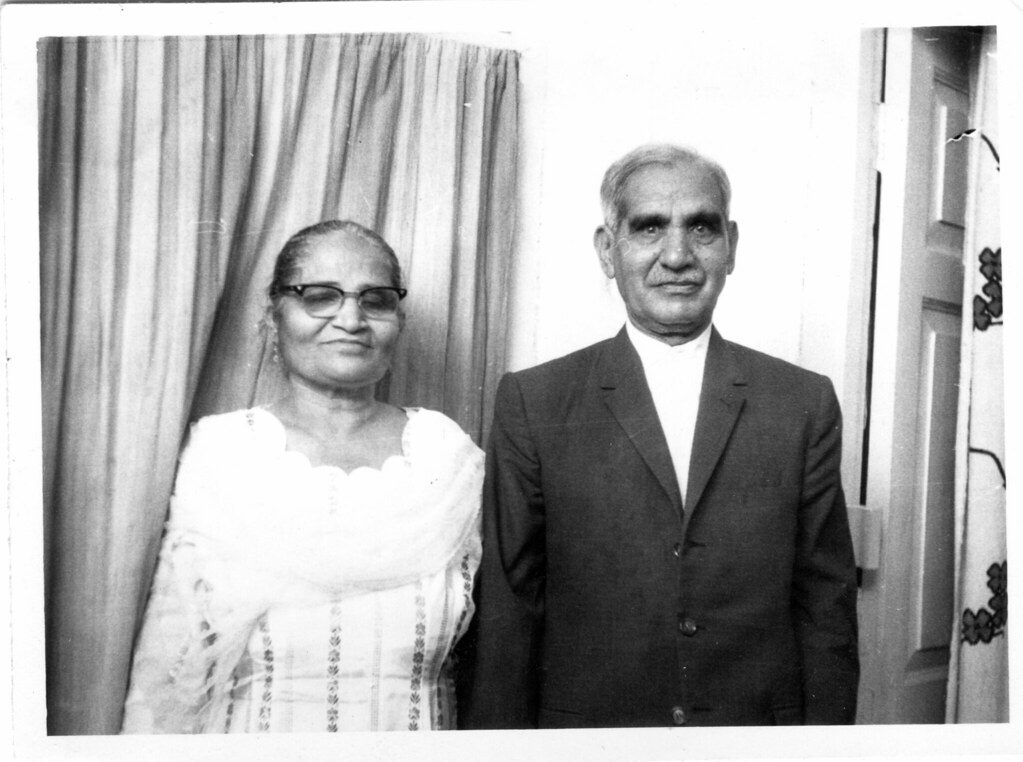
Of course, I'd met Abid's sister, Safia, as soon as we reached Britto Road. I'll write much more about her later because, of all the family members, I probably became closest to her over the months we stayed in Pakistan and throughout the balance of my marriage. She and her husband, Nayyir, even attended Farida's wedding in 2001, after I separated from Abid and moved to Bass Lake. 

That left the brothers:
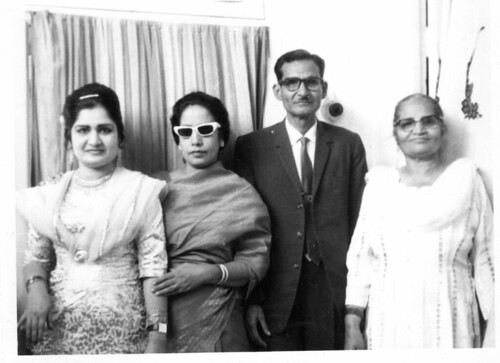

  • Akhtar, the oldest. This picture is of sister Safia, Akhtar's wife (whose name I don't remember), Akhtar, and his mother. I can't remember ever visiting his home. He'd always come to visit us at his mother's home.
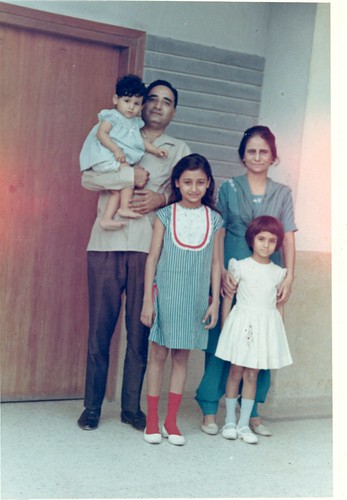


  • Tajammul, who is a doctor and the owner of several hospitals in the Karachi area. He married Aijaz, who is also a doctor. She is the daughter of Dr.Sir Ziauddin Ahmed, a prominent, well-respected physician and educator, for whom Tajammul and Aijaz named their first hospital and the teaching university the family operates. They raised four children, Asim (not in the photo) and Rubina (here standing between her mother and father), who are also doctors and well-known in their fields. As you can see, they were children at the time Abid and I visited. Sabina (in front of Aijaz) and Arif (in arms) are the youngest of their children.
Although Akhtar was the oldest brother, Tajammul would be the person the entire family turned to whenever there was a need. He was the acting patriarch of the family and became its de facto head upon the death of their father.

At the time of our arrival in Karachi, Tajammul and Aijaz were in the process of building a new residence in the suburb of North Nazimabad, a new development where some of the most prosperous Pakistani citizens of that era lived. The home was large, open and airy, two stories, with a spiral staircase connecting the floors. When complete, it would be a house to rival United States mansions. That wouldn't happen for a long time.
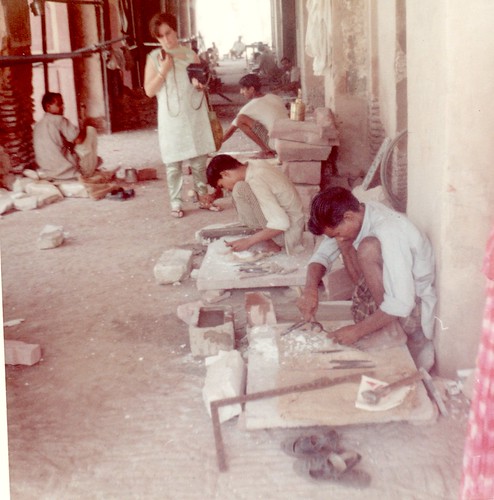


Construction in Pakistan takes place over years, not months, so the house was nowhere near complete when we first saw it. A rudimentary kitchen had been installed upstairs in what would later become a bedroom as the  modern, efficient "official" kitchen took shape downstairs. The servants  prepared meals upstairs, carried them downstairs to serve and then transported dishes and utensils back upstairs to be washed. It was not an easy process, made more challenging by the work schedules both Tajammul and Aijaz observed. It seemed like there was never a time of day when one meal or another wasn't fin preparation.

The situation would probably have been unbearable if it hadn't been for the quiet, moderating temperaments of both Tajammul and Aijaz. They brought calm to what would otherwise have been a tempestuous existence.


As I recall, the downstairs kitchen finally became serviceable shortly before our departure.

No matter the chaos that sometimes reigned over Tajammul's house, it was always a haven for us, particularly during the last month of our stay.  And best of all, it had western plumbing.


Next Episode:  The Homeboys

Sunday, September 13, 2009

Khyber Dreams: Chapter 4 - An Intro to Pakistani Life

I was completely blown away by the welcome Abid, Farida and I received when we arrived at Abid's childhood home on Britto Road. His parents lived there, along with Abid's brother Altaf and Altaf's wife and baby and Abid's two younger brothers, Akhlaq and Munawwar.

During the years Abid and I had been married I'd learned a bit about Pakistani customs. I knew that Pakistani elders depended on their children and grandchildren to take care of them as they aged. In the Pakistani version of Social Security, it was (and is) completely normal for adult children (and their children) to share a home with elders. Abid's parents appeared to be in their late 70's and slowing down. Having their children around allowed them to continue to live in the home they'd occupied for many years. In addition Abid's sister Safia, who had her own home with her husband in the area known as Defense Society, came to her mother's home daily to make sure everything was okay. She would help prepare the food and take some meals with them.

While we "Americans" often prided ourselves on our acceptance of other ethnicities, I'm embarrassed to admit that my own family had not been welcoming to Abid. To the day she died, my mother never completely accepted him, although she cherished her two granddaughters. Here his family was, opening their arms to me and greeting Abid as if he'd never been away. I honestly had not expected that, and I was grateful.

As soon as we'd lugged our suitcases upstairs to the living space, Abid and Safia gave me a tour of the house. I was struck by how similarly it was arranged to Mexico City houses I'd lived in. Built in a square with a large open area in the middle, the various rooms all opened onto the two-story-deep central "courtyard."

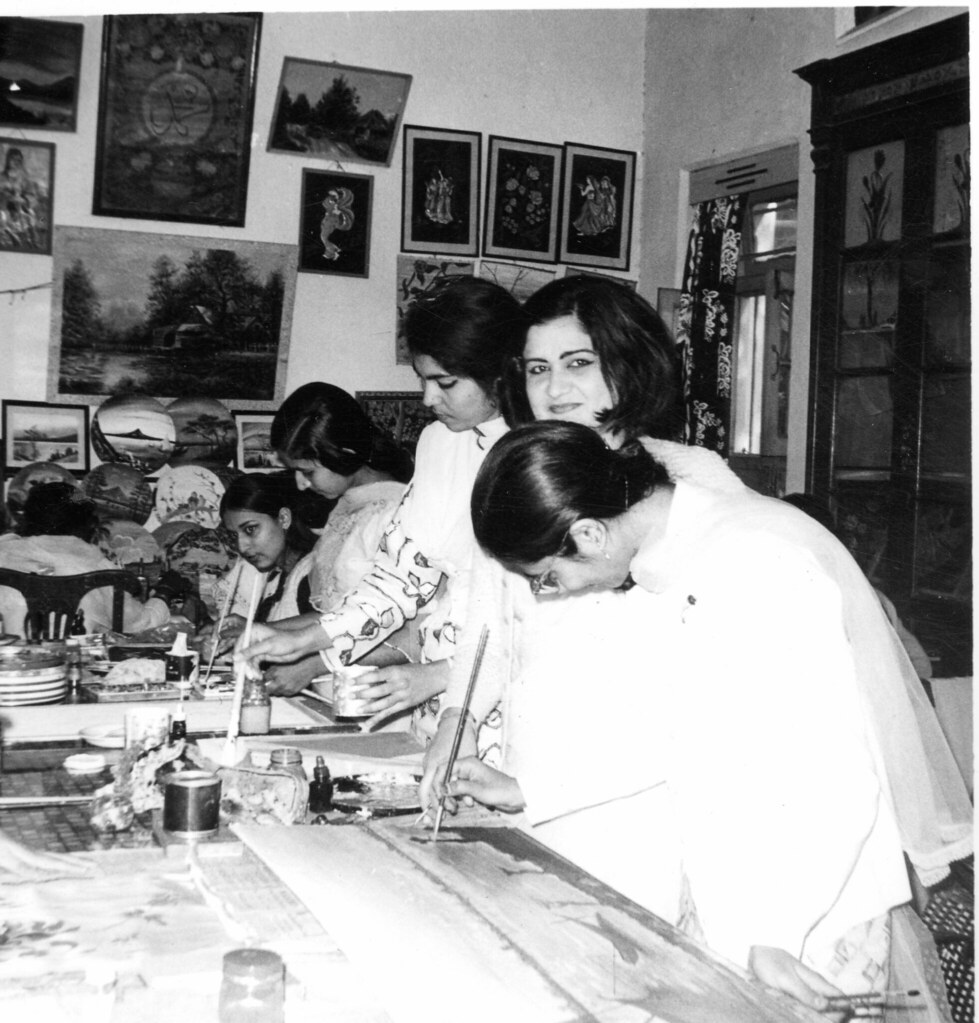
The rooms were large, the walls thick and stuccoed (very like southwestern adobes) to insulate against the heat and encourage air flow in a country where temperatures regularly reached into the 90's and beyond . . . with 90% humidity. As I remember, there was a living area, a kitchen, another living area which Safia used as a painting studio, a bedroom where Abid, Farida and I parked our stuff, another small bedroom, which was the only air-conditioned space in the house.

After all these years I can't remember where Abid's parents slept. I suspect the bedroom they assigned to us was theirs and that they probably slept on pallets in the living area during our stay. They were always awake before me during our entire stay, so I can't say for sure.

Abid rushed to show me the bedroom he occupied before he left for the States, atop the roof of the house and accessed by a set of rickety stairs. For years he'd told me about it.

An accomplished athlete, Abid loved competing at cricket, soccer and bicycle races. His parents, however, saw no value in sports and forbade him to participate in anything not having to do with book learning. The rooftop room allowed him to escape whenever he wanted by shinnying down the mango tree that hugged the side of the house. Even if his parents discovered his absence, they couldn't do anything about it until he returned. They'd chastise him, he'd listen--and do it all over again.

One area I remember vividly is the bathroom. And I use the term "bathroom" advisedly. Although I'm sure sanitary facilities have changed over the past 40 years, in many homes of that time, the "toilet" was an old-fashioned  hole in the ground. I hadn't known about this in advance, so it took a few moments (!) to get my mind around the facilities. I've never been known for my coordination, so the prospect of having to squat on my haunches was a bit daunting.  I adjusted, however, although I never liked it and never accomplished it with any grace.

Both Abid's sister Safia and brother Tajammul had recently built or remodeled their houses prior to our arrival and both included western bathroom facilities in their construction. I swear they timed the building to coincide with our visit. That's how accommodating they were to this complete stranger. Although Tajammul's house hadn't been fully completed by our arrival, he and his family made sure it was most comfortable when we visited or stayed there.

As a concession to my western sensibilities the family provided toilet paper for my use. The usual way of cleaning oneself was by use of a water pitcher. (I'll leave it to your imagination as to how that works.) That's a big reason why you won't see Pakistanis eating with their left hands . . . the left hand is for cleaning, the right is for eating.

The shower occupied a tiny room next to the toilet. I can't remember how or if the water was heated. Karachi weather was hot and clammy, so a hot shower probably was not necessary and not desired. In fact,  as soon as I'd exit the shower, the stifling humidity made me crave another. I never felt really clean for more than a minute during my entire time there, except during our visit in Peshawar toward the end of our stay.

I came to admire the agility of Pakistani women (and men) who could sit on their haunches as they worked, whether it was cleaning or cooking. Each morning Abid's mother would squat for an hour as she prepared chapattis from scratch and cooked them over what in Mexico was called a comal, a flat piece of metal or cast iron set over an open fire.I have no idea what it was called in Urdu, the language of Pakistan.

Perhaps the trickiest part of my earliest days in Karachi was figuring out who was who in Abid's family. He is one of ten children, and all of them except for three sisters lived in Karachi. A parade of brothers and their families appeared over the next few hours, anxious to welcome Abid home and meet his family.


Next episode:  Keeping 'em straight

Wednesday, September 9, 2009

Khyber Dreams: Chapter 3 - Family Ties


Abid's parents couldn't have been more welcoming. Everyone there, including Altaf's wife and baby, Abid's sister Safia and the students who came to the Britto Road house two or three times a week to study oil painting with her gathered around, anxious to meet the returning brother and glimpse the American wife and baby daughter.
Another hurdle overcome.

I began to relax a little.
Farida, on the other hand, screamed at the approach of anyone other than Abid and me. She adamantly refused to consider getting to know any of her Pakistani relatives. To her, of course, they were completely foreign. She didn't understand a word they said (even though many spoke excellent English), and she didn't recognize the saris and shalwar kameezes  the women wore.
That hurdle would hold fast the entire three months we remained in Pakistan. Pakistanis adore children, and I sympathized with Abid's relatives who wanted nothing more than to hold and cuddle her--not to mention I was aching for a break from the constant child care.

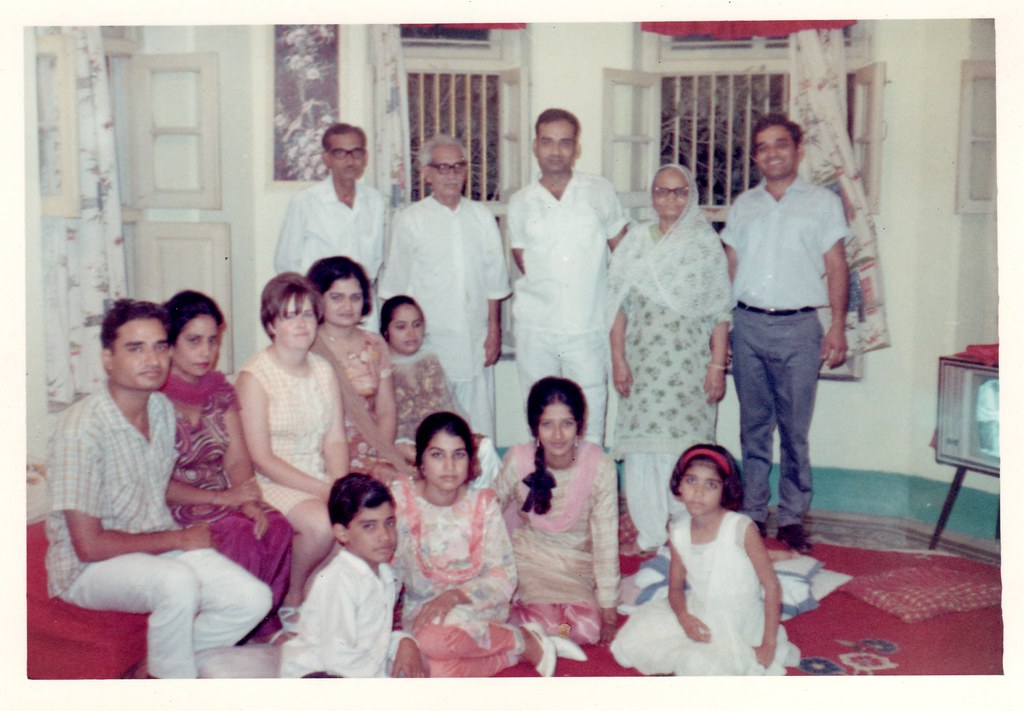
Group photo:  The family gathered at Abid's parents' house on Britto Road, shortly after our arrival. I'm surprised the photo reproduced as well as it did, being 41 years old and not stored under the best of conditions.


Standing, from left:  Abid's oldest brother Akhtar, Abid's father, brother Altaf, mother, Abid.   
                               
Middle row, seated, from left:  brother Munawwar, Akhtar's wife, me, sister Safia, (unknown).

Seated in front are Akhtar's children, I believe.


If I look tired, it's because I was . . . Pakistan is 12 hours ahead of California and a whole world away. It took at least a week before Abid, Farida and I didn't wake up in the middle of the night expecting to see the sun shining. That was my first experience with jet lag. Although I'd spent a lot of time in Mexico, Mexico City wasn't enough of a time change to be uncomfortable.


Not only that, but going from being an only child into a family of ten brothers and sisters--not to mention hundreds of cousins, uncles and aunties--required a huge mental adjustment. There was never a time when the house was empty of people, and that was a togetherness I simply wasn't used to.


To be continued. Next episode:  An Intro to Pakistani Life

Tuesday, September 8, 2009

Khyber Dreams: Chapter 2 - Welcome Home

Abid lifted the camera high over his head, prepared to slam it into the floor of the customs room after the agent on duty demanded he hand it over. Suddenly another officer burst through the double doors which led to the passenger greeting area, placed his hand on the examining agent's arm and whispered in his ear.

Turning to Abid, he apologized. "I am so sorry for this inconvenience," the obviously-senior officer said. "Please come with me."

Abid lowered the camera as the junior agent hurriedly stuffed everything back into our suitcases and shut them.

As we exited to the waiting room, Abid searched for familiar faces. By that time I was exhausted, and I honestly don't remember who met us, but I suspect it was Abid's brother, Altaf. Whoever it was welcomed us, hugged his brother, greeted me warmly and led us to the waiting vehicle. I sighed in relief. One relative down, hundreds to go.

The first thing I remember upon stepping out of the airplane was the overwhelming smell of diesel fuel. That odor followed me the entire time I was in Pakistan. Before that time a diesel smell evoked pleasant memories from my time in Mexico City. In Karachi, the scent invaded everything, even inside residences and businesses, because taxis and buses spewed smoke out their tail pipes, accompanied by the ever-present sound of motorized rickshaws.

Traffic in Karachi resembled that of Mexico City, only worse. Although stop signs and traffic signals marked the intersections, they seemed to be ignored by everyone. Defensive driving took on a whole new meaning as we careened through the streets toward Abid's childhood home on Britto Road.

So far, so good. Now for the real test--meeting Abid's mother and father.