Sunday, November 20, 2016

The Promised Land, Mt. Nebo and Arrival at Petra

From the Citadel we said goodbye to downtown Amman and traveled through the suburbs and out into the country toward our next destination, Mt. Nebo, known as the place from which Moses viewed the promised land.

As we left the crowded city, we passed open fields where tents were randomly pitched. Our guide, Zac, told us these were Bedouin camps, where Arab nomads live as they have lived for centuries with their goats and camels. We would see a number of these throughout the day as we traveled through the deserts of Jordan on our way to Petra.

Mt. Nebo is a hill a little less than 3,000 feet high and is also where tradition says Moses died and was buried. As with most Biblical sites, there is controversy and conjecture over this.


A monument to honor and memorialize Moses


A sign points the way to the Promised Land.
And this is the actual view. 
The "Brazen Serpent" statue as talked about in the book of Numbers, created by
Giovanni Fantoni.
There are the remains of a Byzantine Church on Mt Nebo which is in process of being excavated and which contains beautifully-preserved mosaics.


Mosaic in the Byzantine Church on Mt Nebo
This camel-hair tent shields the church excavation
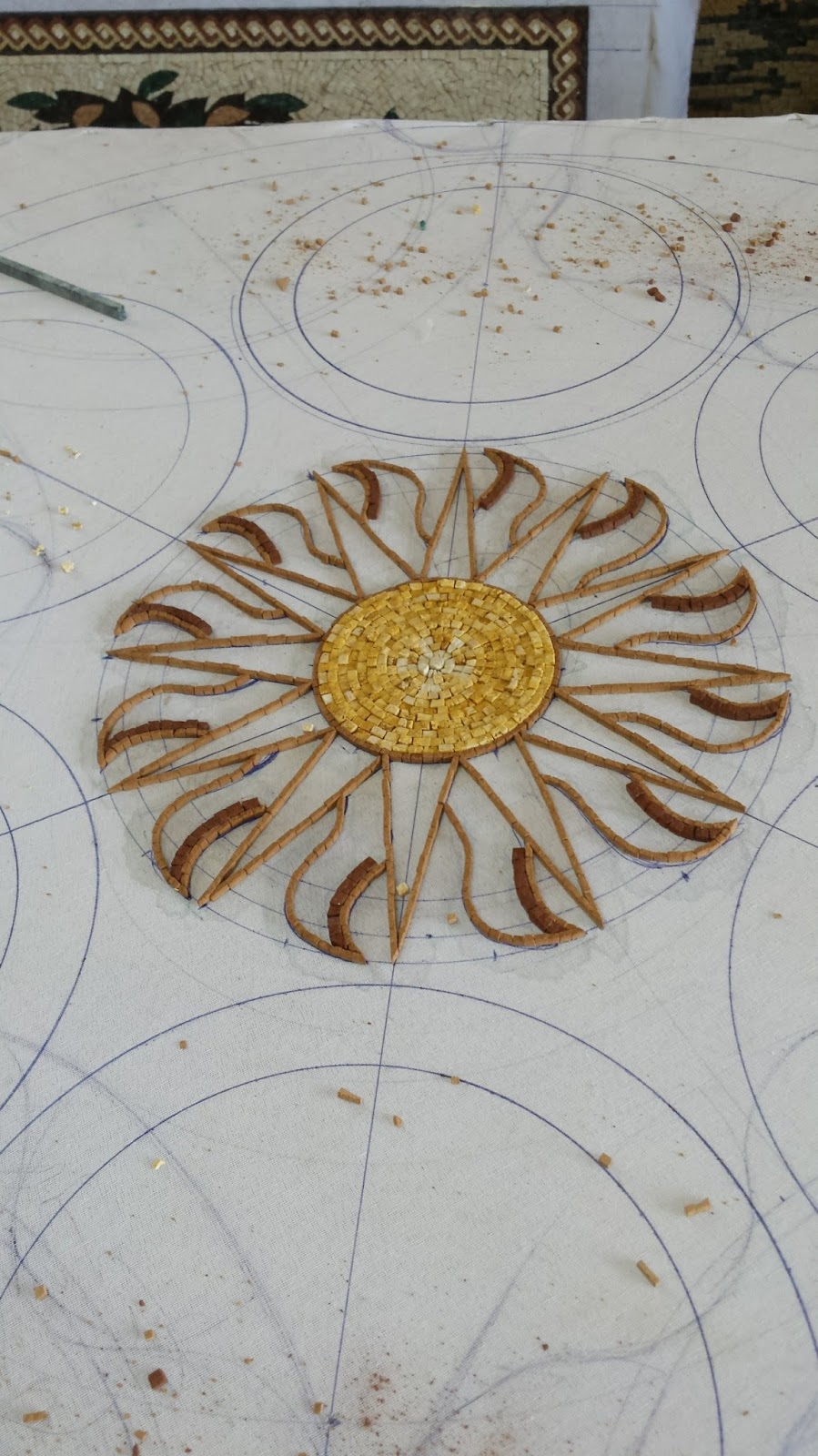
Leaving Mt Nebo, we journeyed a short distance away to a School of Mosaics in the town of Madaba. We saw every type of mosaic art in every stage of creation. Incredibly intricate, every piece must be constructed by hand, and these artists are taught the necessary techniques.


The early stages of creation
Approaching completion

and one last magnificent piece:

A table-top with inlaid mother-of-pearl
Some of us bought products to take or ship home, but reluctantly I passed on the opportunity.

We'd had a full morning, and it was now lunchtime. Perish the thought that we should miss a meal!

Our lunch spot was once again unique; a lovely shaded outdoor patio at Haret Jdoudna.


This is the restaurant's entrance.
Just inside the entrance resides the owner's vintage Mercedes


These steps led to the restrooms upstairs and illustrate the beauty of the patio where we dined.
Down the street, within walking distance of the restaurant, lies Madaba's arguably most important site--the Bysantine Church of St. George. Inside the apse of the church is its most impressive feature:  the Madaba Map, which is the oldest extant map of the Holy Land and especially Jerusalem. Unlike maps of our day, it is not oriented toward north but rather toward the east, oriented toward compass directions.


Exterior of St George's Church
Interior of St. George's
A quick walk back to the restaurant and our waiting bus, and we were on our way, at last, to PETRA.

This would be the longest drive we'd experienced to date, and we took advantage of the time to nap or catch up on emails with the bus's wifi or just gaze at the barren Jordanian desert.

The terrain turned more mountainous as we approached Petra, and the road twisted in hairpin turns as we neared the summit. Suddenly before us, perched on a cliff, was a magnificient Crusader castle:


This is known as Montreal Crusader Castle, and I found an interesting YouTube video describing it and showing some of its interior. Unfortunately we only got to view its exterior.

Speaking with Gila, she told me she'd sat where she had an excellent view of the very narrow road. "The wheels were right on the edge," she shook her head. "I thought we were awfully close."

Luckily my view wasn't that good.

Next stop:  Petra, land of the Nabateans.


Tuesday, November 15, 2016

The Original Philadelphia

Did you know that Amman, Jordan, was once called Philadelphia, and that it was built on seven hills? That's just one of the facts we learned when we visited the Citadel in the center of Amman. On top of one of those hills, right in the center of the city is a set of ruins that date back to prehistoric times and still bear the remnants of Roman, Crusader, Ummayad and Byzantine civilizations, and probably more.

The entrance to the Citadel, with the pillars of the Temple of Hercules in the distance.
The Citadel sits atop the highest point in Amman and thus affords a magnificent view of Jordan's most populous city.


This view looks from the Citadel site south toward the Roman theatre in the right center of the photo. 
The population of Amman is more than 4 million, and it looks like all of it is shoved together surrounding the original site.


How do they cram so many buildings into such a small space? Where is any open space (other than the Citidel site)?
The remaining artifacts are the Temple of Hercules,


Remains of the Temple of Hercules
the Ummayad Palace,


Ummayad Palace

Detail of the Ummayad Palace

and the remains of a Byzantine Church, mostly in ruins.


The modern city of Amman peaks over the rubble of an ancient Byzantine church

Next stop:  A view of the Promised Land from Mt. Nebo.

Friday, November 11, 2016

Amman, a Five-Star Hotel and a Bevy of Beauties

After a marvelous afternoon exploring Jerash, we boarded the bus for our next stop:  Amman and the Kempinski Hotel. 

Jordan's tourism has been in a bad way, and most of the three- and four-star hotels have closed. Too bad for us. We were forced to hole up in a li'l ol' five-star dive in the middle of Amman.

I got only one really lame photo of the exterior of the hotel. Believe me, this does not show the beauty or the luxury of the place. 

Everything about this hotel screamed "elegance" and "refinement" (except perhaps me). Oh, it really probably whispered. Screaming isn't too elegant.

I spent some time sorting through my gear and getting stuff ready for the next day's travel before heading downstairs to have a drink before dinner.

Arriving in the lobby, I wandered around until I found Shelby and her mom, Linda, in the hotel bar. Directly behind where they were seated, they pointed out the swimming pool area, outfitted for a very elegant wedding. Shelby even got a brief video of part of it. Unfortunately, even though she'd shared it with me and despite my newly-honed video skills, I couldn't save it for you, but what I can share with you is:

Food. 

Food became an all-important part of each day, and each meal we ate, as mentioned before, seemed better than the last. The cuisine at the Hotel Kempinski Amman was probably the finest yet both in terms of taste and presentation. Our dining room space was elegantly-appointed and inviting. The photos below were from our breakfast. 


 My finished product--and it tasted even better than it looked. That orange juice was fresh-squeezed.


Despite our enjoyment of the five-star luxury treatment at Hotel Kempinski Amman, we schlepped our luggage downstairs and got it loaded on the bus for the next stage of our journey:  exploring a bit of Amman, Madaba and then onward to PETRA.

Our first stop was at the King Abdullah Mosque, just a couple of miles from the hotel.

The exterior was stunning.


This is the only mosque in Amman that openly welcomes non-Muslims, and then only on certain days. Luckily this was one of the days.

Our guide, Zac, directed us into the gift shop and indicated that the women should go to the back area where lovely robes awaited us. We needed to be covered from head to foot. Even though we'd already dressed ourselves properly, so we thought, we donned this:


This photo, courtesy of Linda Carey, shows us at our "best." Oh, my.

The men, on the other hand, had no special dress other than to have long pants.
Linda Carey's photo of Zac, our guide, which shows the incredible ceiling and the size of the mosque.
Amazing calligraphy adorned the walls and ceilings.

The men line up as Zac, second from left, shows some of the men in our group how to pray.


It would be difficult not to be overwhelmed by the beauty of this building and the art it contains.

Next stop:  The original Philadelphia.


Thursday, November 10, 2016

Jawdropping Jerash

Amazing. Astounding. Fantastic. Stupendous. Marvelous. Gorgeous. Beautiful. Have you noticed that those words and others of the sort seem to populate my posts? That's because everything we saw fit those parameters.

Jerash was even more so. 

Jerash is said to be the largest Roman ruin still in existence outside of Rome. I'm not sure any of us had ever heard of Jerash before our arrival, and none of us expected to see anything of its size . . . except perhaps Petra. This was beyond our imagining.


This is a video of Bedouin Police playing bagpipes and drums in the theatre at Jerash. 

When we first entered the ruins via Hadrian's Arch, I was pretty impressed already.


You can gauge the size of the arch by the size of the people standing inside it.


You could start to believe that I was fascinated with the graceful arches of Jerash, and you'd be right. I also loved the play of light on the limestone contrasted with the brilliant blue of the sky.


Modern Jerash in plain view behind ancient Jerash. This is so typically Jordan, I found.

A look down the Cardo (main street) from the forum area

Beautiful column detail

This gives you an idea of the expanse of Jerash. It just kept going and going and going . . .
 we'd turn corners, and there'd be even more

A fallen arch

Column detail in the forum

Columns through the pepper tree branches

Bedouin Police in the theatre in Jerash

Theatre seats.  These are steeper than they look, and I worried about getting back down after
I went partway up. But I made it (obviously).


The stage in the Jerash theatre
The earthquake of 749 AD which devastated Beit She'an also toppled Jerash. 

Here is a link to a video which gives a pretty good view of the Jerash ruins. And here is a link to a map of Jerash, illustrating the layout of the ruins.